
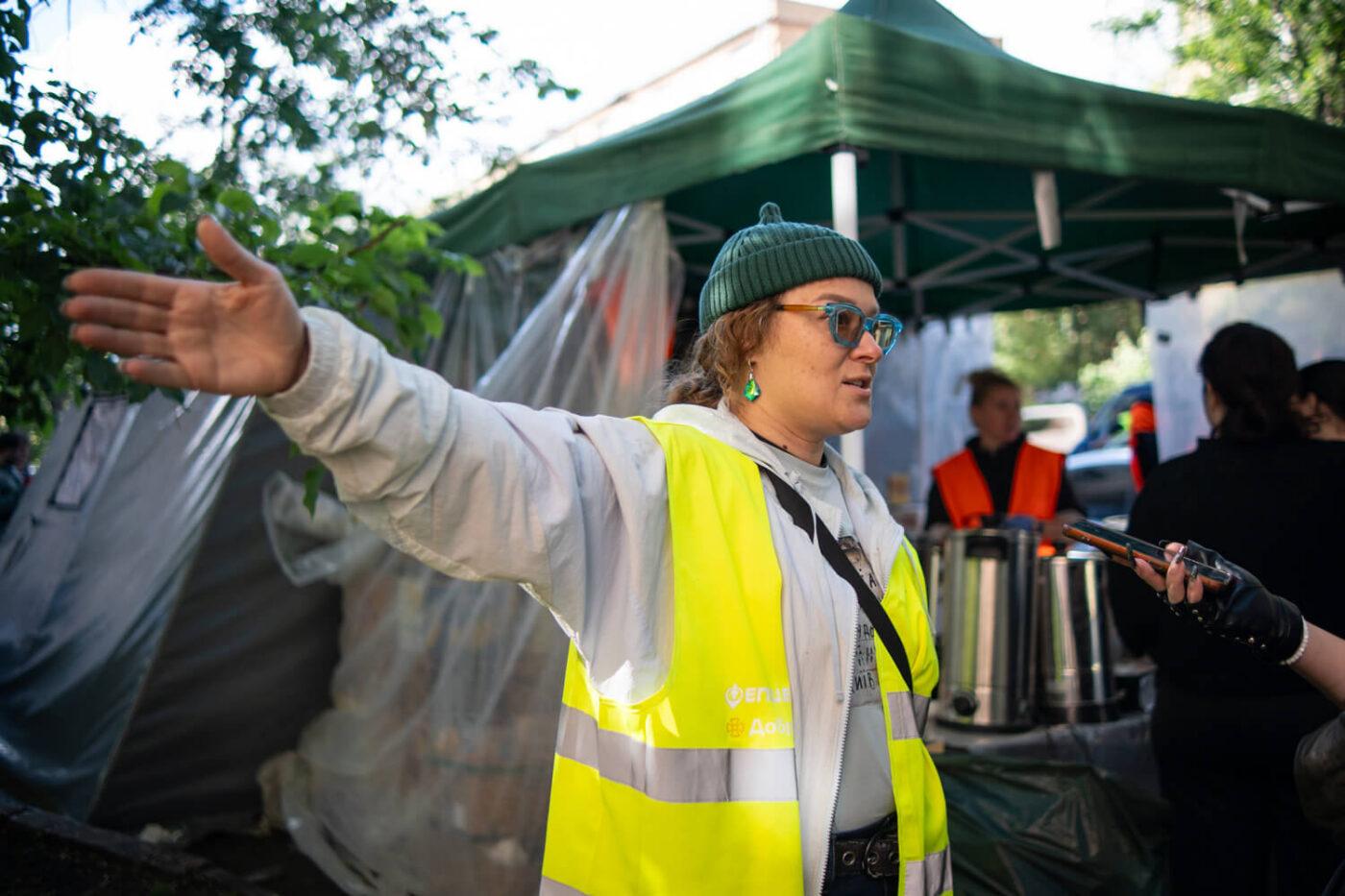
After Russian attacks, she arrives at places where apartment buildings have shattered windows, no electricity, water, or gas, and residents still do not know where to begin the recovery. Kateryna Terekhova coordinates volunteer “subordinates,” building materials, a field kitchen, and the first emergency repair works so that people in damaged buildings can get through the hardest days after a strike.
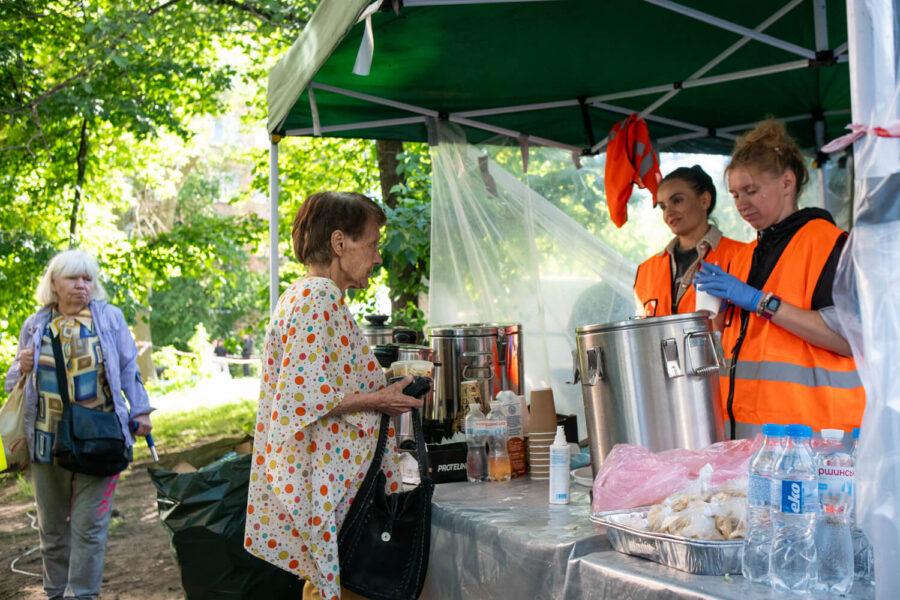
“Usually, on the first day after a strike, there are plenty of organizations like the Red Cross and World Kitchen Program that arrive with global-scale budgets to feed the affected residents and the State Emergency Service, for one day. Today we have been working here for the fourth consecutive day. This building was lucky—the missile only grazed it. But there is still no electricity, no gas, and no water—and there won’t be for quite some time. The district was hit in many places—there are numerous impact sites here. Around our location alone, there are more than 40 buildings. And, of course, it is a коммунal catastrophe,” explains Kateryna Terekhova.
From Restaurant Management to Working at Strike Sites
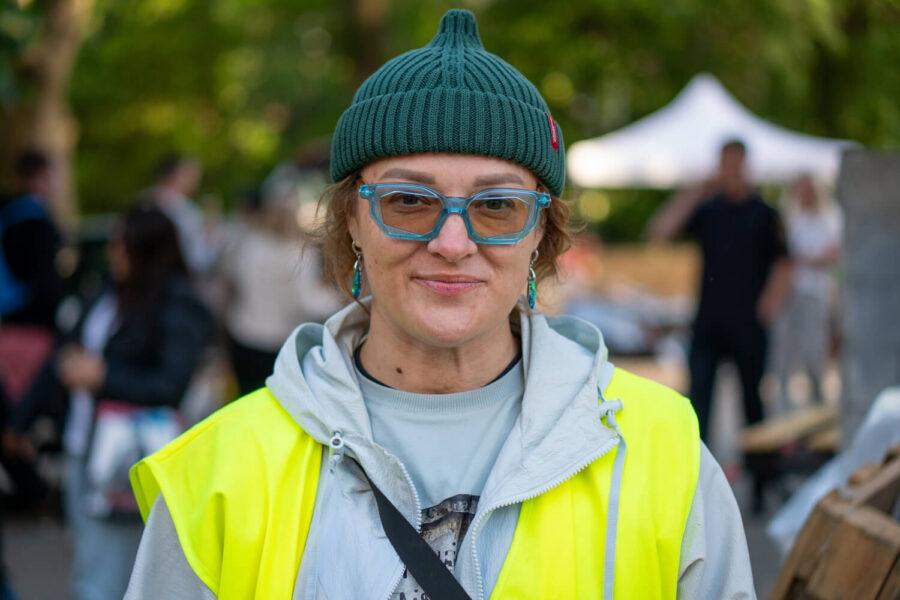
Kateryna is a Kyiv resident of Donetsk origin. She has lived in Kyiv for almost 30 years and has long considered it her city. Before the full-scale war, she worked in the restaurant and club industry, as well as in festival management—leading teams, launching venues, and overseeing complex operations in large spaces.
“I no longer see myself in the commercial sector. I want to continue connecting my work with helping people, children in Ukraine, and my Kyiv. Volunteering is my way of life, my profession, my responsibility, and the place where I realize myself the most. Since 2022, it has been a matter of principle for me that all my work brings real benefit to people,” says Kateryna.
Her pre-war experience proved invaluable once the full-scale war began. Kateryna had not only worked in service and team management—she had often launched venues from scratch or participated in their reconstruction.
“Almost every venue I worked at, I either built from scratch or reconstructed. We redesigned spaces, optimized kitchens, ventilation systems, engineering networks, and changed operational logistics. I always loved starting projects from scratch. It was important for me to know a building down to the smallest detail: where the electrical wiring, water supply, sewage, and ventilation systems were located. Back then, I explained it by saying that a manager should know their facility well enough to safely shut everything down on their own in any emergency, close the venue, and evacuate people. At the time, it never even crossed my mind that one day war would make this knowledge essential for survival,” she recalls.
Kateryna began volunteering during the Euromaidan. At the time, she managed a venue nearby and set up a place where protesters could warm themselves and receive assistance. She also purchased construction materials for barricades, shovels, saws, and other necessary supplies. After Russia’s aggression began in 2014, she sent generators and construction materials to the military.
Then, on February 24, 2022, her life changed completely. Within just a few days, the activist built (!) a kitchen capable of serving 1,200 soldiers defending Kyiv Airport.
Today, all of her work is charitable. She supports three institutions for children with disabilities, established a shelter for internally displaced families in Zakarpattia, and coordinates the Help Mukachevo humanitarian warehouse, which continues to receive shipments from Germany. But the main focus of her work today is responding to the consequences of Russian shelling in Kyiv.
“This is what I dedicate most of my time and energy to today. It is a direction that emerged during the full-scale war and has become an important part of my life,” says Kateryna.
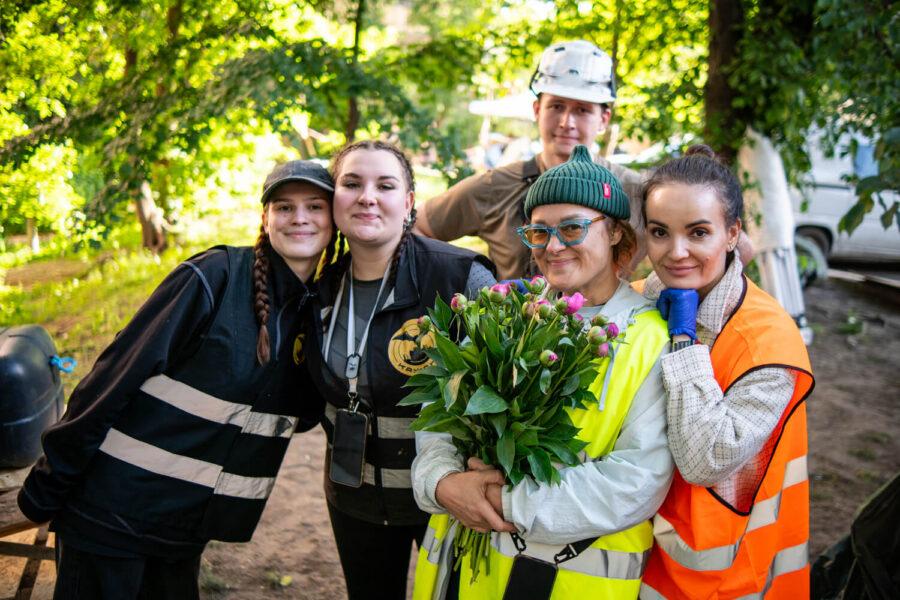
“There Is a Whole Workflow”
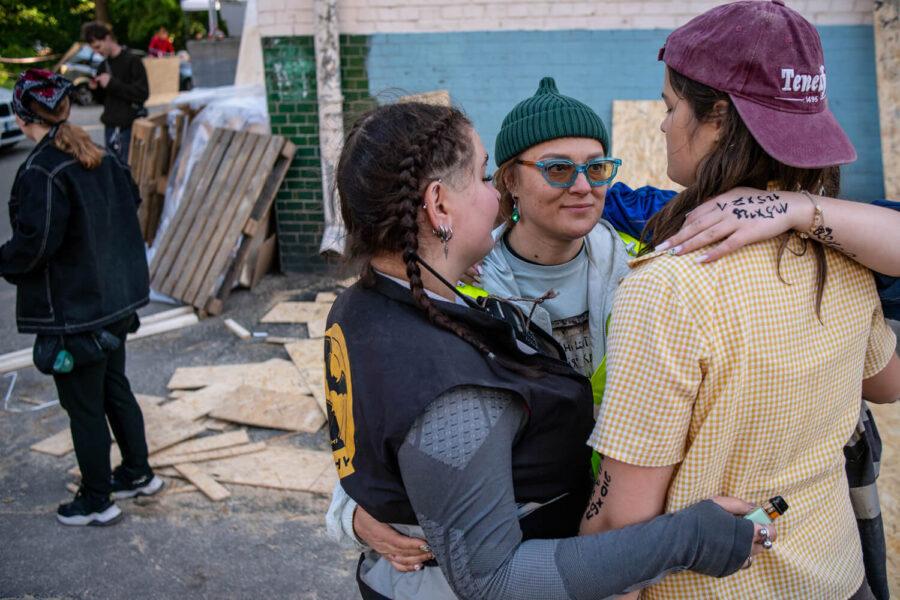
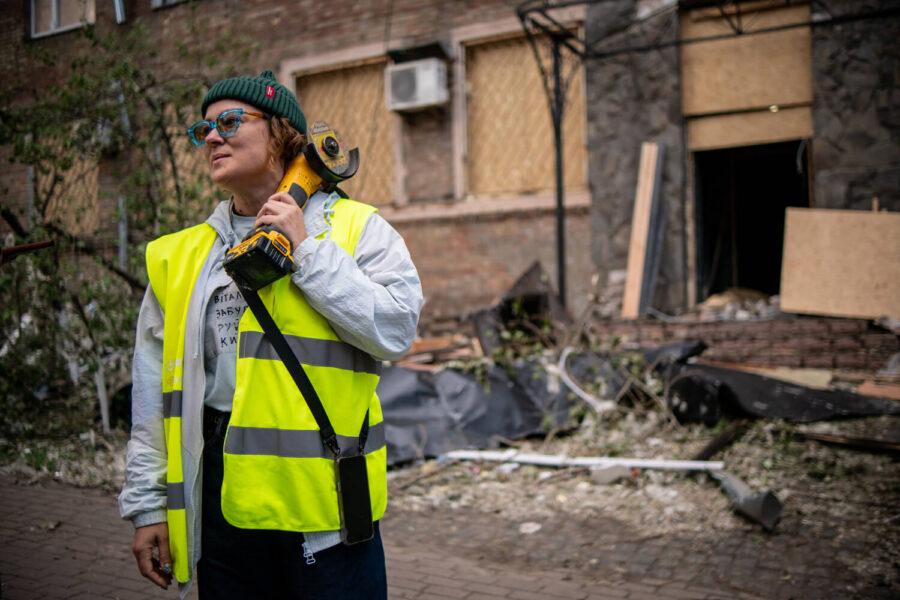
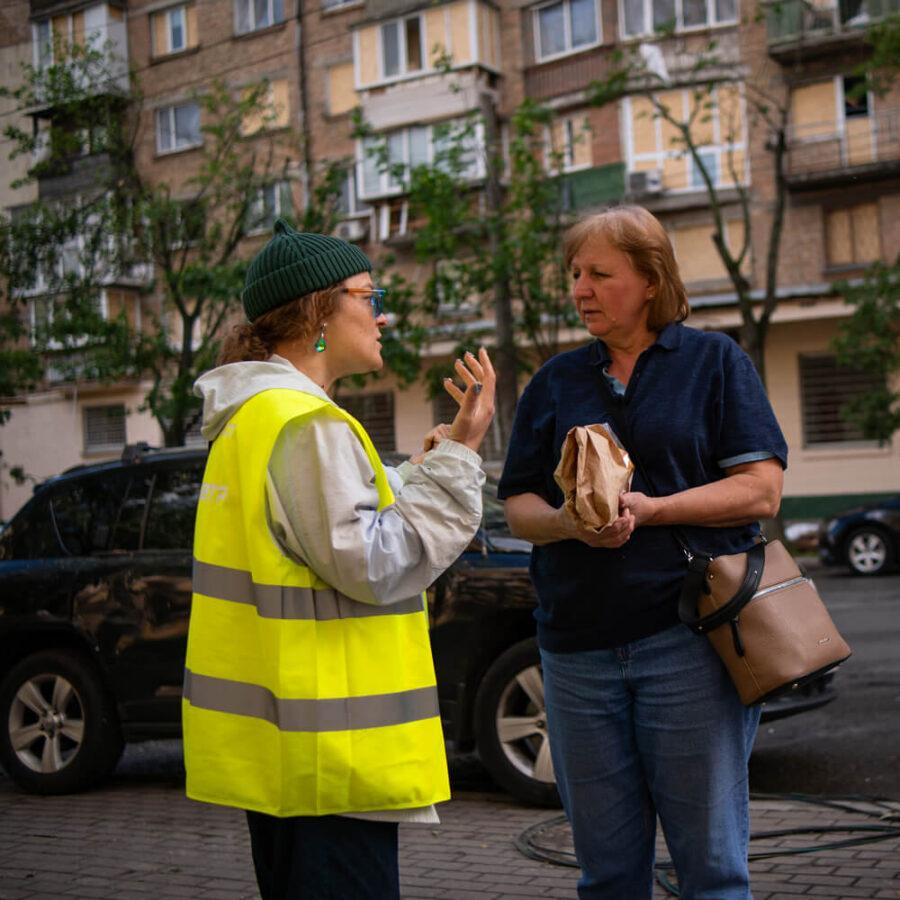
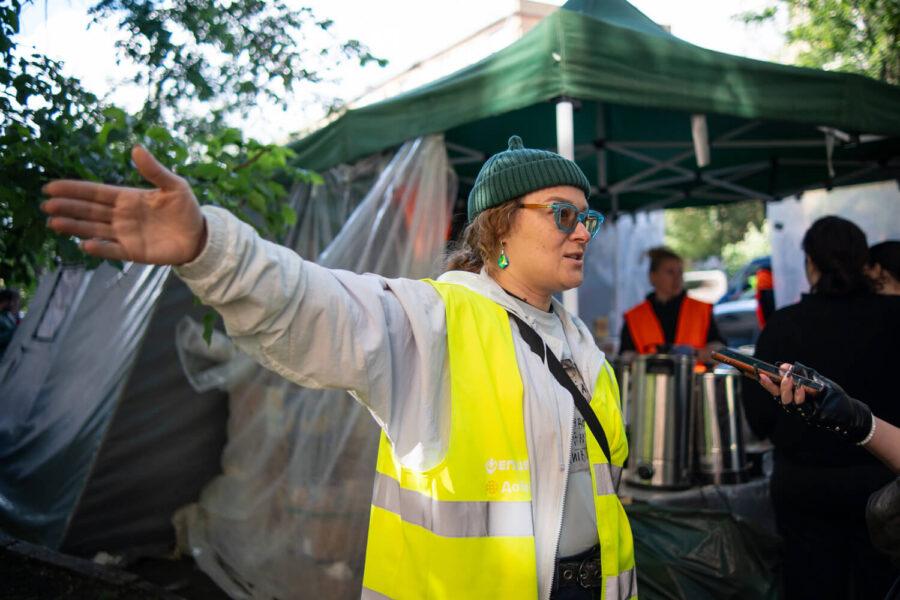
We meet Kateryna at the site after a massive attack. On the fourth day after the strike, the rubble and debris have already been cleared, but not all the windows and doors in the building have been boarded up. Kateryna coordinates the material-cutting stations she organized herself, assigns volunteers, and sometimes even explains the work sequence to construction workers. It is difficult to speak with her for even five minutes—someone is constantly calling her away.
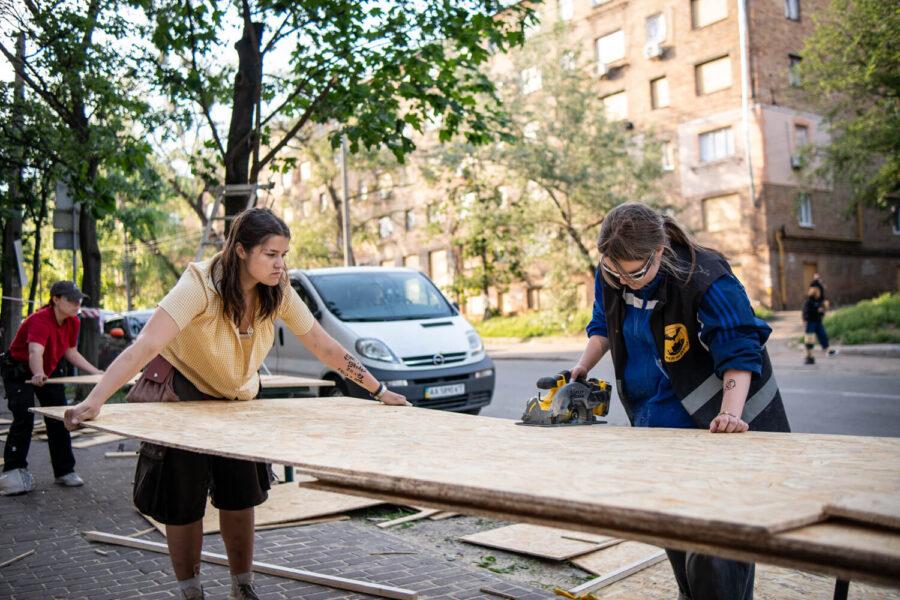
“We usually set up several stations where we cut materials to fit the dimensions of the windows. There is a whole workflow. We register residents’ requests and assign volunteers to take window measurements. They return to the cutting station with the measurements: they submit a list of apartments, the dimensions, and how many panels need to be cut. The cutting station prepares everything; the volunteers collect the materials and then go from apartment to apartment, boarding up windows and doors. At the same time, we clear out everything inside the apartment that has been destroyed—walls, windows… Right now, we cannot enter several stairwells because the load-bearing structures must first be reinforced so that the building does not collapse completely,” explains Kateryna.
She is referring to a building that was struck by a missile. It passed through the structure and exploded inside. The building is made of brick, and Kateryna says that this is precisely what helped it withstand the impact.
“Yes. Buildings with a monolithic reinforced concrete frame are also quite resilient. This material may be partially damaged by fire, but it often remains standing. It combines both flexibility and strength. Such buildings do not collapse the way panel apartment blocks do, as we saw after previous attacks,” she says.
At first glance, it seems that Kateryna has a professional background in construction. But that is not the case.
“I do not have a formal education in construction. By education, I am a practical psychologist, although I never completed university. So even I sometimes find it difficult to explain where this ability comes from—to read blueprints quickly, understand engineering diagrams, or navigate construction processes. I joke that it must be some gift from a previous life.
The full-scale war showed me why all these skills had been part of my life. Today, they allow me to organize emergency recovery work effectively, work on construction sites, and help people return to their homes after Russian attacks,” says Kateryna.
Following the massive strike on Okhmatdyt, Lukianivka, and the Holosiivskyi district in the summer of 2024, Kateryna has not missed a single major attack on Kyiv after which residents of damaged buildings needed assistance. According to her, the only district where her team has not yet worked directly on housing recovery efforts is Obolon.
The core of her rapid response team consists of around 200 people. These are volunteers who come to help after almost every large-scale attack.
“The number of volunteers depends on the scale of the tragedy. The greater the destruction, the more people respond to the call for help. We are all very different. But we are united by one shared desire—to help. It is young people who inspire me the most.
Young men and women have become one of the main driving forces of our team. Many of them are still students, while others have only recently finished school. They are ordinary young people: they joke, swear, vape, and after a difficult day, they might go out for coffee with friends or meet at a bar. But when tragedy strikes, they are the first to come and help strangers. They give me the greatest hope. When you work alongside young people like this, you clearly understand that our country has a future. And it will be in reliable hands,” says Kateryna.
Kateryna’s team works in cooperation with the State Emergency Service of Ukraine (SES) and coordinators from the Kyiv City Military Administration (KCMA). After every shelling attack, they are the first to go to the hardest-hit locations and assess the scale of the damage.
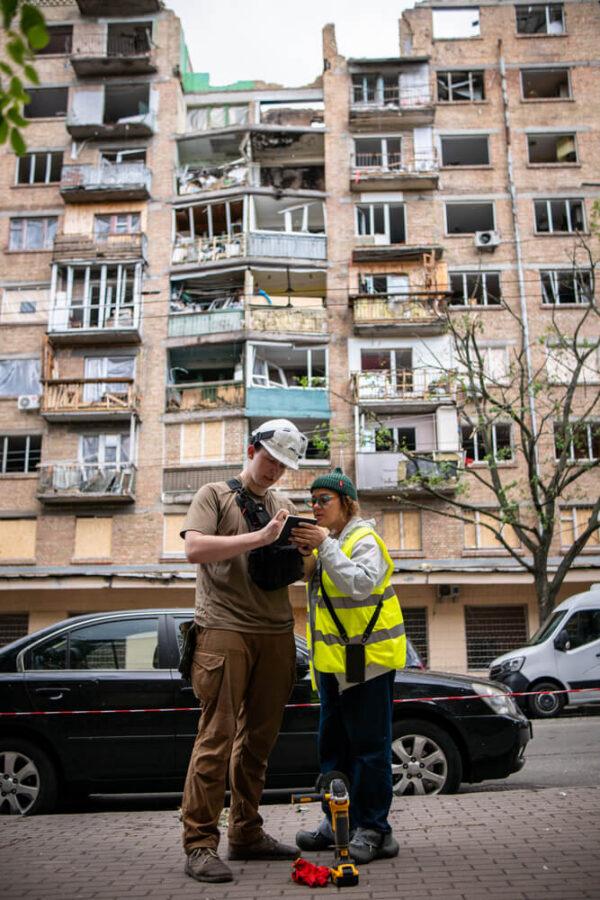
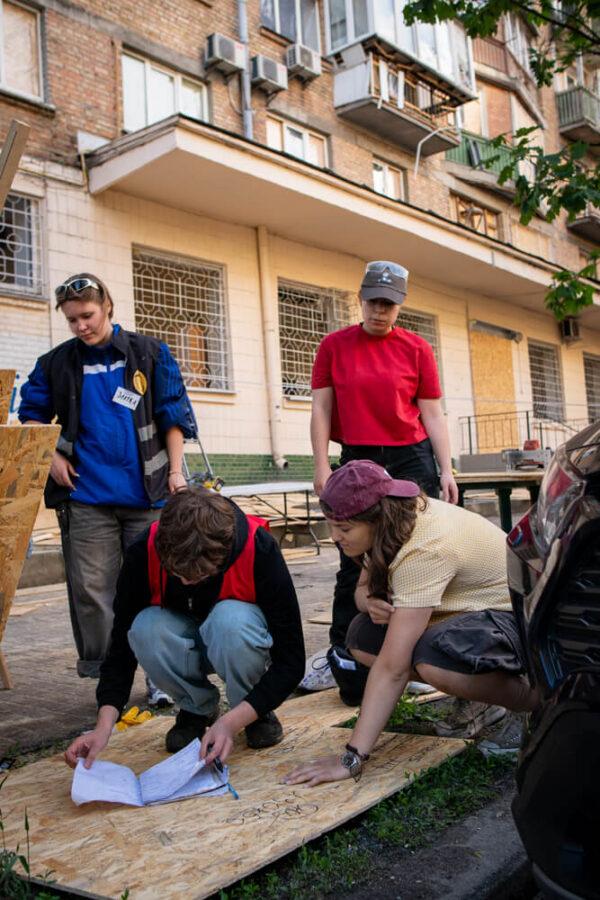
How the Team Works After a Shelling Attack
We meet Kateryna at the site after a massive attack. On the fourth day after the strike, the rubble and debris have already been cleared, but not all the windows and doors in the building have been boarded up. Kateryna coordinates the material cutting stations that she organized herself, assigns volunteers, and sometimes even explains the
“It is young men and women who have become one of the main driving forces of our team. Many of them are still students, while others have only recently finished school. They are ordinary young people: they joke, swear, vape, and after a difficult day they might go out for coffee with friends or meet at a bar. But when tragedy strikes, they are the first to come and help strangers. They give me the greatest hope. When you work alongside young people like this, you clearly understand that our country has a future. And it will be in reliable hands,” says Kateryna.
Kateryna’s team works in cooperation with the State Emergency Service of Ukraine (SES) and coordinators from the Kyiv City Military Administration (KCMA). After every shelling attack, they are the first to go to the hardest-hit locations and assess the scale of the damage.
“The first hours after a strike belong to the rescue workers. They extricate people, extinguish fires, search for the dead, and provide assistance to the injured. We use that time to get a little rest after a sleepless night in the shelter, have breakfast, gather the team, and prepare. After that, we post on social media how many volunteers are needed and what kind of assistance is required. Most often, we need people, water, coffee, energy drinks, food, and construction materials. In most cases, we purchase the construction materials ourselves—thanks to donations from individuals and the support of businesses,” she explains.
How Can Each of Us Help?
Kateryna’s biggest dream right now is to have her own warehouse for construction materials. It would allow the team to respond more quickly after shelling attacks and avoid relying on complicated logistics and searching for materials at the very moment when help is most urgently needed.
“There are many ways to help us. If you have a space of at least 50–100 square meters that could be used as a warehouse, it would be invaluable support for us. If you can donate construction materials or help purchase them, that would also be an enormous contribution,” says Kateryna.
Material assistance is not the only way to get involved. After shelling attacks, Kateryna publishes specific requests on social media: how many volunteers are needed, what materials or supplies are required at the site, and what kind of assistance is most urgently needed at that moment.
“We always honestly state exactly what is needed at any given moment. Everyone can contribute in whatever way they are able,” she says.
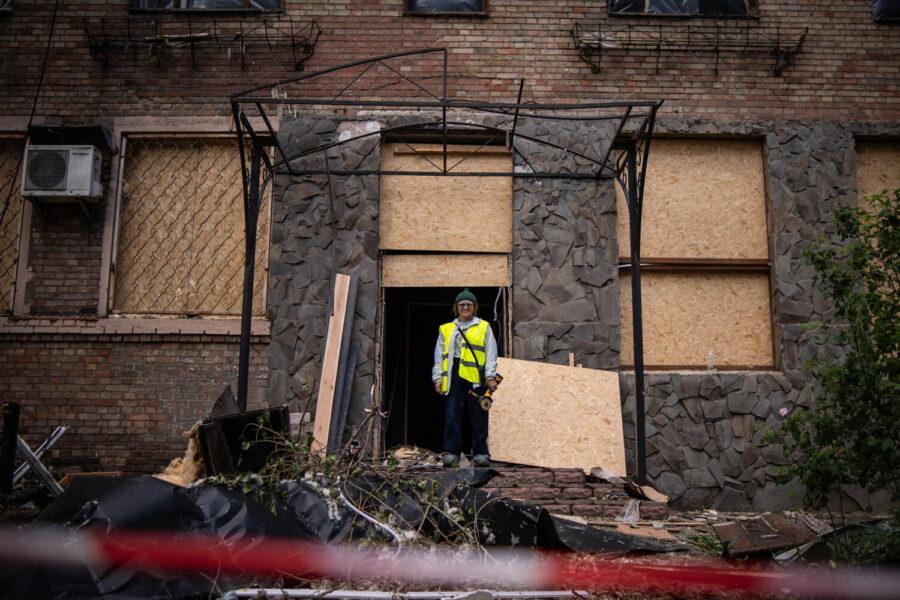
Photo: Roman Chyhrynets