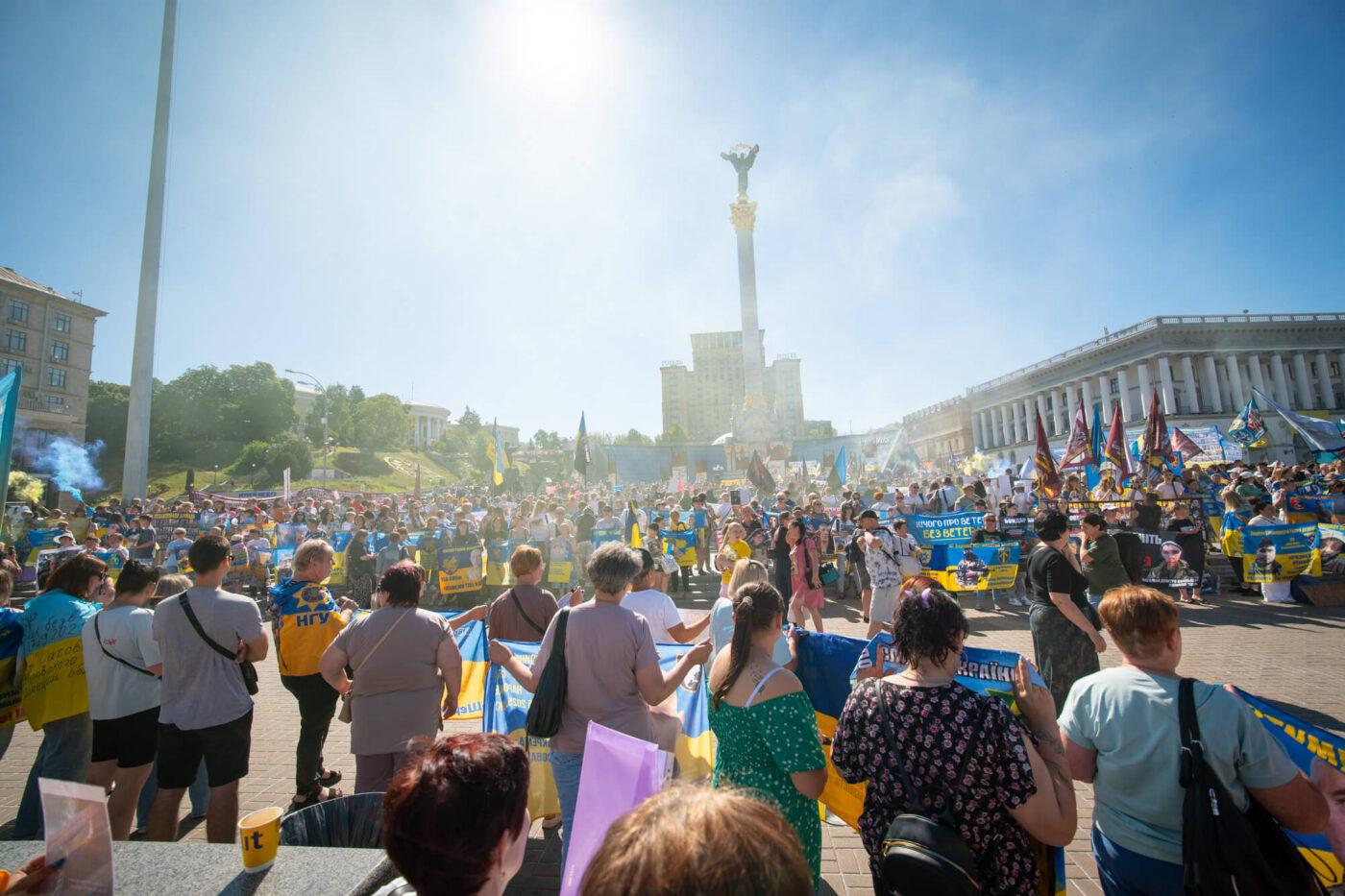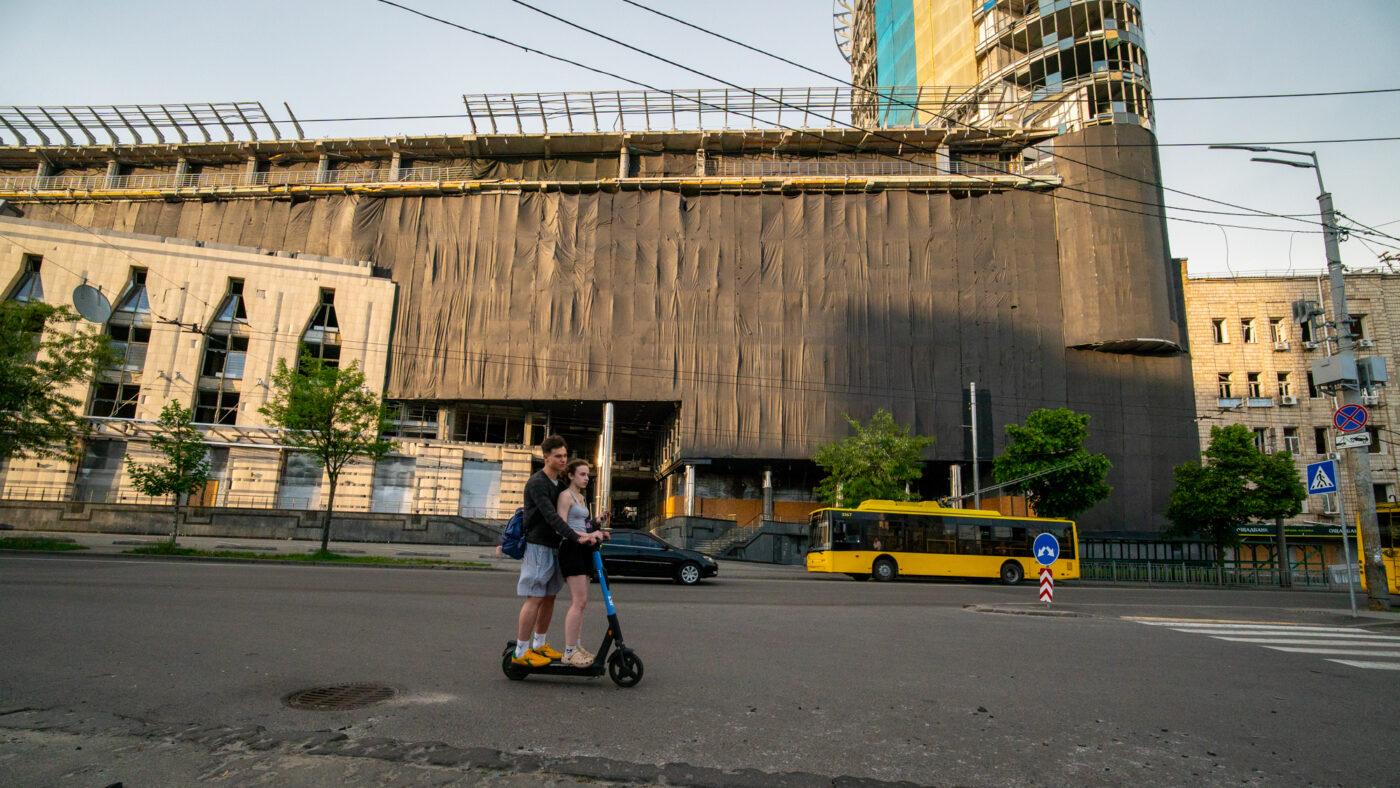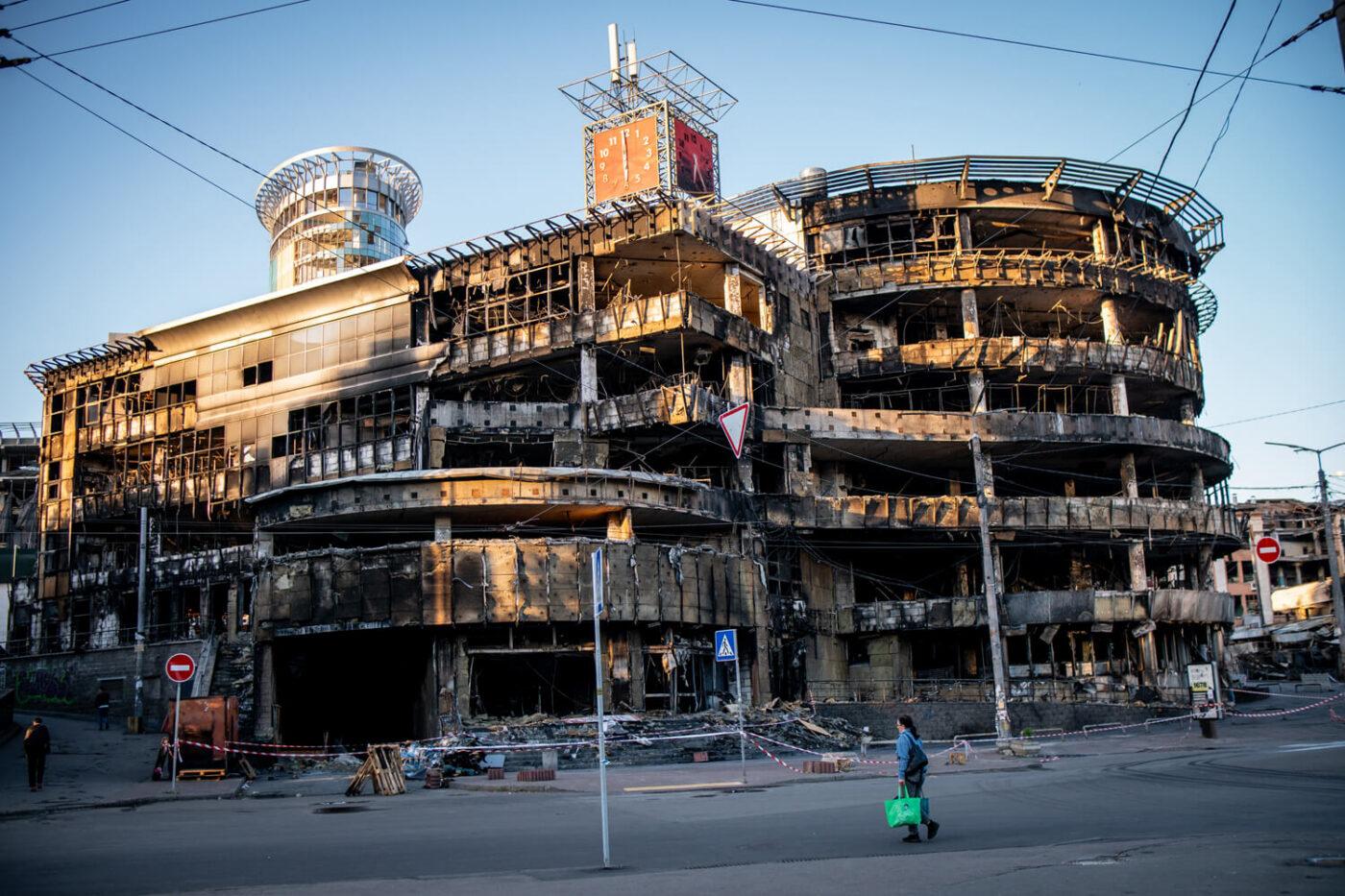


Every day in Kyiv, as in the rest of Ukraine’s cities, begins with a minute of silence in honor of those who have died as a result of Russia’s war against Ukraine: traffic lights turn red, public transport stops, and supermarket checkouts close. But Kyiv remembers its heroes not only through silence — its tribute can be found in Avenues, memorials, street names and other city landmarks, murals, parks and squares dedicated to defenders, and in vast cemeteries.
“They Are All Family Here at Lisove”


The Heroes’ Alley at Lisove Cemetery is one of Kyiv’s main burial sites for fallen soldiers who defended Ukraine. Actress Anna Yaremchuk-Bobalo comes here at least once a month. She is the widow of military director Oleh Bobalo-Yaremchuk.
The woman was born in Crimea, while her future husband was born in Lviv. They met in Kyiv, at the Ivan Karpenko-Karyi Kyiv National University of Theatre, Cinema and Television. On the eve of the full-scale war, Oleh Bobalo-Yaremchuk began filming a docudrama about the history of Ukraine, “The Heart of the Universe.” But in 2022, he had to put art aside and take up arms. First, he volunteered for the Territorial Defense Forces of Kyiv’s Darnytskyi district, and in May he joined the Armed Forces of Ukraine. He was killed on December 20, 2022, fighting near Bakhmut, in the village of Klishchiivka.
Today, Anna drives to the cemetery amid air-raid alerts and explosions. She learned to drive only after her husband’s death, in his memory:
“When Oleh was leaving, as it turned out, for his final battle, he made me promise that I would learn to drive. We had a car. And so I taught myself after losing him — now I’m slowly learning to drive. I’ve already fulfilled one of my promises to Oleh. There was another one — to learn English. But I’m having problems with that. I’m studying, I’m trying, but as it turned out, it’s much harder than driving.”

The widow of the fallen hero walks between rows of flags above the soldiers’ graves, approaches her husband’s burial site, lights a memorial candle, wipes the monument, and leaves a small stone:
“Somehow, I don’t feel him here. I come here as if I were coming to his spacesuit, to his body, to his earthly body… I’ve come to understand that Oleh is a part of me, a part of our daughter Liza. But I have a tradition: whenever I return from somewhere, I always put a little stone from that place by Oleh’s grave. So today I brought stones from Venice.”

Anna recently returned from the Venice Film Festival, where she took part as an actress in the film “Camouflage.” It is a German-produced film about the fate of a Ukrainian student-emigrant after the beginning of Russia’s full-scale invasion of Ukraine.
“The film was made by one of our guys — a Ukrainian who moved to Germany back in 2013, Mykyta Hibalenko. He graduated from the University of Television and Film Munich. ‘Camouflage’ is his graduation film, which was selected for the Venice Film Festival and received many wonderful reviews. Thanks to this, I had the honor of speaking about Oleh at one of the world’s greatest film festivals. I asked the European creative community not to forget that the hell depicted in the film is something we are still experiencing. And I asked European artists, and people in general, not to forget this, not to grow tired of our war, as they have become tired. And for all of this to end as soon as possible. With our victory, of course,” Anna explains.
This time, the actress brought stones to the cemetery not only for her fallen beloved, but also for a fellow Crimean — a soldier with the call sign “Crimea”:
“I left a seashell for him. His grave is covered, almost like Crimean pebbles. And so I brought ‘Crimea’ a seashell to add to it. They are all family here at Lisove. All of them. We are like one family now…”


“I Would Really Like There to Be Some Kind of Art Installation in Kyiv Dedicated Specifically to Oleh”
Kyiv has also honored the memory of Oleh Bobalo-Yaremchuk by posthumously presenting his family with the “Honor. Glory. State” medal. It is an official distinction awarded by the mayor of Kyiv to Kyiv residents who are defenders, veterans, and volunteers. There is also a display at the alma mater of the Bobalo-Yaremchuk couple featuring photographs of artists who were killed:
“Oleh isn’t the only one there — there are many wonderful actors and directors who are now part of the Heavenly Army. Of course, I would really like there to be some kind of art installation specifically for Oleh, in his honor and in his memory. But I understand that I am very weak. There are widows who work on these things, who pursue them and achieve results, but I simply don’t have the strength for all of this.”
Anna recalls that in the first months after losing her beloved, she desperately wanted to see the name of her fallen husband, his photograph, or his artwork on every pole:
“For example, if you drive across the Darnytskyi Bridge, you can see murals dedicated to fallen soldiers, painted by their widows. It costs quite a lot of money. In principle, I had the opportunity to put a plaque about Oleh on a building. But when I started working on it, it turned out that I needed permission from some academic commission, and then another one, and another one — in short, a mountain of paperwork. It just makes you give up, you know? You want people to remember on their own and to come forward with ideas. Ideally, I would have liked to receive many different proposals so that I could choose from them. But throughout all this time, four years, no one has approached me with anything. I understand that this is unrealistic, because only those who feel the pain will remember and do everything they can to ensure that their loved one is not forgotten. I do what I can: through my Facebook posts, on every platform, both in Ukraine and abroad, I talk about Oleh.”
That is why Anna Yaremchuk-Bobalo now dreams of creating a modest art installation at her late husband’s burial site:
“I want to install at least a miniature director’s chair next to his photograph, with his call sign written on it.”


Kyiv’s Main Urban Symbols of Remembrance for Fallen Heroes
At present, the main urban art installation honoring the Kyiv residents who have fallen while serving in the military during our current war is the Memorial to Fallen Kyiv Defenders. It was unveiled at the intersection of M. Hrushevskoho Street and Petrivska Alley on Ukraine’s Defenders’ Remembrance Day, August 29, 2021. Today, the memorial is surrounded by city lightboxes displaying nearly 1,500 photographs of the fallen. The sculpture itself features military memorial tags bearing call signs such as “Tsymbal,” “Master,” “Gosha,” and others


A key Kyiv site commemorating fallen volunteers, military personnel, and law enforcement officers from across Ukraine who died defending us against Russian aggression is the long Wall of Remembrance stretching along the walls of St. Michael’s Golden-Domed Monastery. It features photographs and biographies of thousands of soldiers. An electronic terminal next to the memorial provides additional information about them.


A little farther away, on Sofia Square, the “Heroes’ Alley” exhibition — “Warriors of Light” — has been set up for the fifth time since August 31. This year, through October 3, it presents 520 stories of Ukrainian women and men who have fallen defending the country in the war.


Yet the Heroes Who Defend Ukraine Are Not Only Today’s Military — Nor Are They Only Military Personnel
Next to the Memorial to Fallen Kyiv Defenders in the war, at 6 M. Hrushevskoho Street, stands a monument to Viacheslav Chornovil. One could say that Ukraine’s state and national independence began with him.

This Ukrainian politician and civic activist was the initiator of the Declaration of State Sovereignty of Ukraine, adopted on July 16, 1990, and the Act of Declaration of Independence of Ukraine, adopted on August 24, 1991. Even earlier, during the Soviet era, he had been one of the leaders of the movement against the Russification and national discrimination of the Ukrainian people. For this, he was repeatedly imprisoned by the Kremlin as a political prisoner.
Under the charge of “anti-Soviet agitation and propaganda,” Viacheslav Maksymovych was convicted three times and spent 17 years in strict-regime labor camps in Mordovia and in exile. After Ukraine gained independence, Chornovil became a member of parliament and a presidential candidate. As early as the end of the last century, he warned us about the dangerous possibility of the war we are experiencing today:
“God grant us the strength to love Ukraine above all else today — so that we will not have to later love it bitterly, having lost it.”
These words crown the five-meter, multi-ton bronze monument to Chornovil, which appears to be breaking through a stone wall. It stands opposite the building that housed the headquarters of the People’s Movement of Ukraine in 1989. Officially, Viacheslav died in a car accident. However, there are well-founded theories that it was an intentional killing, as this Ukrainian politician and defender of Ukraine was strongly opposed to the spread of Russian influence in the country.
Nearby, on one of the buildings on Hrushevskoho Street, are memorial plaques dedicated to other Ukrainian heroes of the national-democratic movement: Vasyl Stus and Ivan Svitlychny.

Near the Golden Gate stands “The First to Defend”: the monument to “Defenders of the Homeland’s Borders of All Generations.” It is located at the intersection of Zolotovoritska and Reitarska streets with Heorhiivskyi Lane, opposite the building of the State Border Guard Service of Ukraine. The monument is the centerpiece of the Border Guard Glory Alley. It was erected long before the current war, in 2004, and this particular location was chosen because Kyiv’s defensive rampart stood here in ancient times.


Yet deeper inside Kyiv, far from the city center, there is also a Border Guard Alley. It is dedicated exclusively to our contemporaries. Although it was opened on the eve of the Russian-Ukrainian war, in 2013, since 2015 it has served as a memorial to “border guards who died as a result of combat clashes while protecting the state border in the east of the country.”

And this is, in fact, in an entire park dedicated to war — Victory Park, in Kyiv’s Dniprovskyi District, near Darnytsia metro station. It was created in 1965. Today, symbols honoring the liberation of Kyiv from the German invaders during World War II stand alongside newer symbols of our own time, already looking toward victory in the Russian-Ukrainian war: a widow mother, the Mound of Immortality, Ukrainian drones, Ukrainian-Soviet war heroes, and contemporary independent Ukrainian heroes…


And, of Course, Kyiv Remembers the Deaths That Marked the Beginning of Our Struggle for an Independent Ukraine in the 21st Century
Crosses, makeshift memorials, candles, a sign reading “Museum of the Revolution of Dignity” standing in the middle of an empty lot, unfinished memorials, devastation, and a small chapel. This is the National Memorial Complex of the Heroes of the Heavenly Hundred, a spontaneous memorial complex rising above Khreshchatyk, in places unfinished, in others abandoned and overgrown with weeds. Here, in the heart of Kyiv, at the beginning of 2014 — even before Russia’s armed annexation of Crimea and the fighting in Donbas — Ukrainian heroes and defenders were killed by enemy bullets during peaceful protests against Russian economic and political influence in Ukraine.


Photos: Roman Chygrynets